
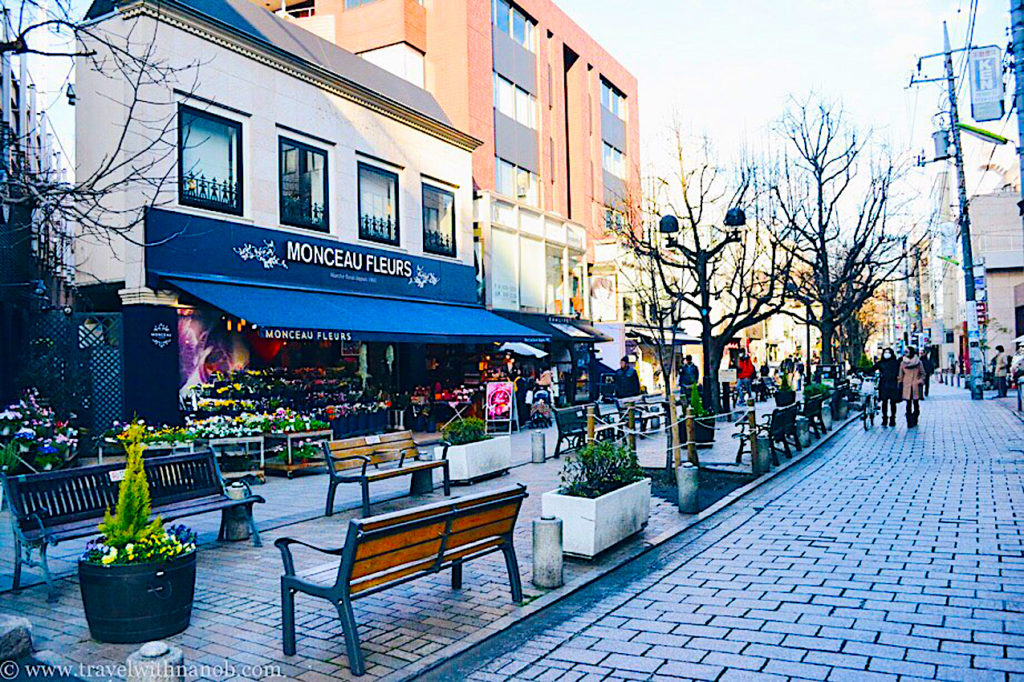
Situated in one of the biggest cities in the world, Jiguyaoka offers the ultimate female experience of the city, as it tends to attract many women with the use of many female charged commerce in the form of “cute cafes, sweet shops and boutiques aimed at a middle-[to]-upper-middle class lifestyle” (Ishida). Situated in Southern Meguro-ko, the neighbourhood houses a large majority of private schools with “premium rents” on a handful of its properties, and is often deemed as a higher-end suburban neighbourhood.
Since the 70s, Jiyugaoka has lived through the days of an economic boom, with more and more businesses coming in and setting up shop, which made a turn during the 80’s and 90’s when female-charged shops began to rise in popularity and started dominating Jiyugaoka’s shopping districts. Female-charged shops, a term used in reference to shops associated with items and services specifically marketed to women, and/or understood as feminine such as housework, craft-making, sweets, interior decoration, beauty and health (Lobo, Tsukamoto & Sanchez 412), were rising concurrently with the number of women entering the workforce by then. Especially with the Womenomics movement during the late Prime Minister Shinzo Abe’s reign, women were able to get out to earn and spend their own wages. As a result, the economy had started seeing women less as an extension of their husbands’ spending and rather as their own independent customers.
The increase of female-charged commercial activity, as Lobo, Tsukamoto and Sanchez suggests, brings some positive outcomes. It is only because of the presence of highly gendered shops that Jiyugaoka had increased its walkability; with highly concentrated areas filled with shops and residential housing, accompanied by wide pedestrian sidewalks. The sidewalks had been strategically done as to accommodate for the shops running during the 90s, when the continuous flow of pedestrians were ultimately important in attracting new customers (414). As a result, the urban planners responsible for the organisation of Jiyugaoka had prohibited the construction of parking areas and certain shops that would require pedestrians either queuing up or stopping mid-way throughout the streets. In addition to this, Jiyugaoka’s planners also had purposely planted trees to discourage biking through the sidewalks, though had accommodated bikers by providing proper bike parking designation areas.
The problem arises, however, when planners selectively cater to women depending on their abilities to participate in consumerism, perpetuating the stereotype women of western cultures are typically associated with, that is the “Mrs. Consumer” (Peiss). This form of commodified feminism must be distinguished from feminism, as it not only fails to stand for the equality and protection of women against the patriarchy, but also pushes for the discrimination against certain women; encouraging the idea that a woman is not worth serving to if they aren’t able to afford the high prices tied to certain spaces.
Ryosai Kenbo and Women’s Education
It’s worth noting that movements towards feminism, in many instances, often are tied to a reductive takes on women based on misogyny, otherwise named essentialist feminism (Mooneyhan).

For example, one of the positive outcomes that had come out of the Meiji Restoration was the introduction of educated women. For the first time in history, women were truly encouraged to formally attend elementary schools and fulfill an education. However, it would be irresponsible to denote this as a sign of feminism, as the movement of women into education was backdropped by the “Ryosai Kenbo” ideology (Patessio 27).
Ryosai Kenbo translates to “Good Wife, Wise Mother”, referring back to the idea that in order for a woman to serve well as a mother, they must be up-to-code in their education in order to better serve their roles as at-home educators for their children. The ideology itself comes to reinforce the idea that the true role of women should be that of a housewife, responsible for keeping the house clean and children pleased and educated, in addition to creating a higher amount of productive labour force.
With a harmful ideology such as this being the driving force of women’s education at the time, it puts into question whether feminism will truly be able to thrive without any patriarchal scheme behind its movement.
Commodified Feminism and its Effects in Urban Planning
Similar to the case of increasingly educated women due to the spread of a misogynistic ideology throughout the country at the time, Jiyugaoka proves to be a case of essentialist feminism — in which women are given more equal opportunities based on “in the pursuit of reductionist motives “essentialist” stereotypes associated with women. Except, in this case, instead of educating women in order to create the perfect housewife, women are further seen as consumers — reduced to their abilities to spend their money — which has, thus, created an increasingly female-friendly and walkable city.
The use of commodified feminism in planning will do as much harm as it contributes to feminism. As Lobo, Tsukamoto and Sanchez mention in their conclusion, the continued commercialisation of the town, though brings in benefits in the form of increased walkability, also increases the possibility of the town becoming an “open mall,” further decreasing the variety of activity that occurs within Jiyugaoka.
They also problematize the issue of “corseting women in their role as consumers [as it] presupposes the only existence of a middle-high class and neglects other economically challenged social groups” (423). This, thus, leads us to another problem, that is the homogeneity in Jiyugaoka. When a town like Jiyugaoka is built specifically to cater to a certain demographic of women, specifically those of middle to upper class, it discourages women of different socio-economic classes from using such spaces. The increased gentrification of Jiyugaoka’s shops just serves to highlight this disparity, as outside of the nearby Shinto temple nearby, Jiyugaoka loses a lot of the local cultures from its location and takes more architectural inspritation from the cultures from parts of the world disconnected from Japan, thus earning its title as “Tokyo’s Little Europe” (Betts).
As a page primarily focused on the spatial relationships of people and the spaces they use, I acknowledge it wouldn’t be beneficial to lose the walkability of Jiyugaoka, and acknowledge the success its planners had in creating safe transportation methods for its women. However, it’s important to admit that with the continued reductive views of women solely as consumers, the city fails to consider how to treat the different types of women, and only serves as an illusion of equality in an otherwise oppressing state for women living outside of the wealthy society Jiyugaoka only serves to.
 The Urbanaissance
Leave a comment